
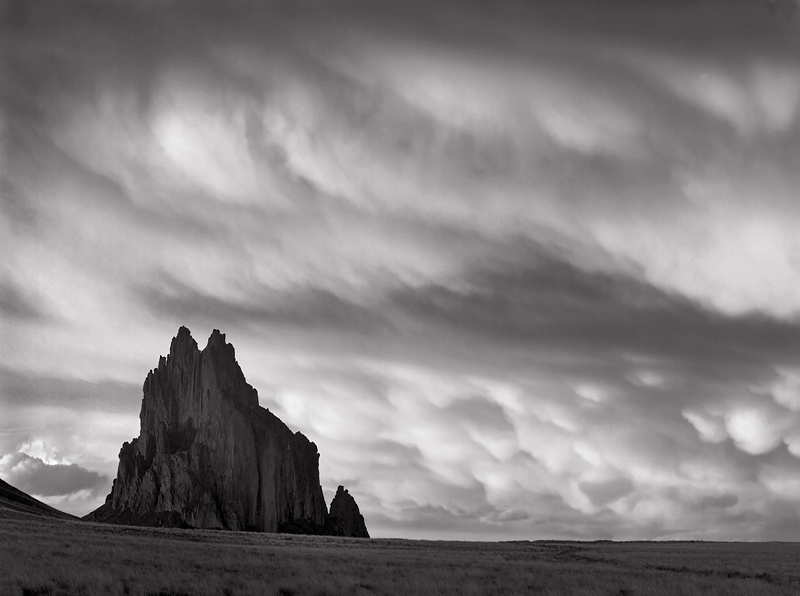
On a stormy afternoon I approached the volcanic landmark called Shiprock, located near the town of Shiprock in the four corners area of New Mexico. The clouds were moving very rapidly, which can be both a blessing and a curse for a large format photographer. I somewhat anticipated the movement of the glowing, cottony clouds across the desert landscape and quickly set up my Super Cambo 4x5 view camera alongside a dirt road. I was very fortunate to get this image, which changed dramatically with every passing second. The print is not very straight forward. In order to make a good print of this image, I used a contrast reduction mask to lighten the foreground area so that subtle detail could show on the print. I also used a highlight mask designed to enhance the luminous forms of the bright billowy clouds. I also experimented with a new mask which I call a "spotting mask". Since the sky had a dust spot which printed dark (due to dust on the negative at the time of exposure in the camera), it was literally impossible to diminish the spot successfully on the print without resorting to etching or other poor techniques. The spotting mask worked beautifully, and the dust spot blends into the sky background almost perfectly. With this new masking technique in mind, I'll be examining a lot of older images that I haven't printed in the past due to large dust spots. I show a before and after version of this print to workshop students at my contrast masking workshops.
Update: I am now teaching the spotting mask method at the advanced contrast masking workshops. On further testing and investigation, I found this mask to be even more precise and effective than my early attempts. Every large format photographer should be aware of this remarkable method of eliminating black spots on prints simply by creating a spotting mask for the original negative.