
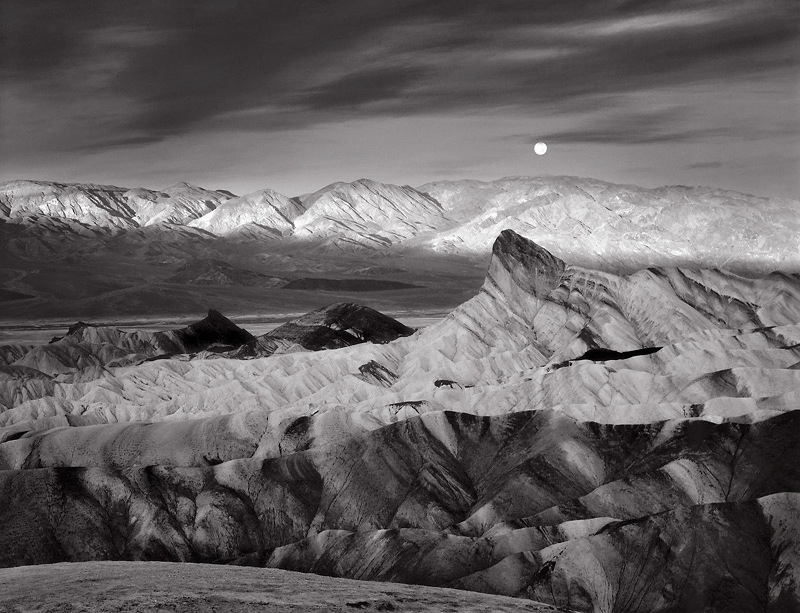
Moon Over Zabriskie Point, 1980. Death
Valley National Park, California
I took this
photograph shortly after sunrise on 4x5 Kodak Tri-X film developed in
Kodak HC-110 developer to normal contrast using a Schneider 210mm Symmar lens. I waited until the sunlight almost
fully bathed the Panamint Mountains. The entire foreground was not yet touched
by the morning light. Within seconds after making the exposure, the clouds
covered the moon making it nearly invisible. Fortunately, the
only negative I exposed contains all the necessary information to achieve
an excellent print. Because of the inherent brightness of the sky compared
to the foreground area, I give the entire sky area of the print a substantial
amount of burning in order to darken it to the degree necessary to obtain
a well-balanced image. The burning is done just to the point of bringing
out the mood of the scene which to me represents a relationship
between the moon and the "lunar-like" landscape of the foreground
mudhills. In order to enhance the liveliness of the foreground mudhills,
a shadow contrast increase mask (SCIM) was used to richen the local contrast
of the foreground area. The use of this mask requires perfect pin-registration
on the enlarger. In addition, the Panamint Mountains received a considerable
amount of localized bleaching with my version of a highlight brightening ferricyanide
formula in order to brighten the mountain range and increase the local highlight
contrast. I also used a fog mask to gently soften the contrast along most of the edges of the print and give a more graceful appearance to the sky. The difference between a straight print made from
this negative and my final "expressive" print is substantial.
Links to specific black and white photography pages